No Tax on Overtime: How the New Deduction Works
No tax on overtime in plain English: which part of your pay counts, how much you can deduct, who qualifies and how to estimate your savings.
- 5 min read
- Source: IRS
- Updated 12 November 2026
Key facts
- Overtime is still taxed. You can deduct the extra half of qualifying overtime pay.
- The yearly limit is $12,500 (single) or $25,000 (joint).
- It shrinks above $150,000 (single) or $300,000 (joint) of income.
- It covers tax years 2025 to 2028.
- Social Security and Medicare tax still apply.
What “no tax on overtime” really means
The name is a little misleading. Your overtime is not tax-free. What changed is that a new federal rule lets you deduct part of your overtime pay when you file your tax return. A deduction lowers the income you are taxed on, so you pay less income tax. It does not make the pay disappear from your paycheck.
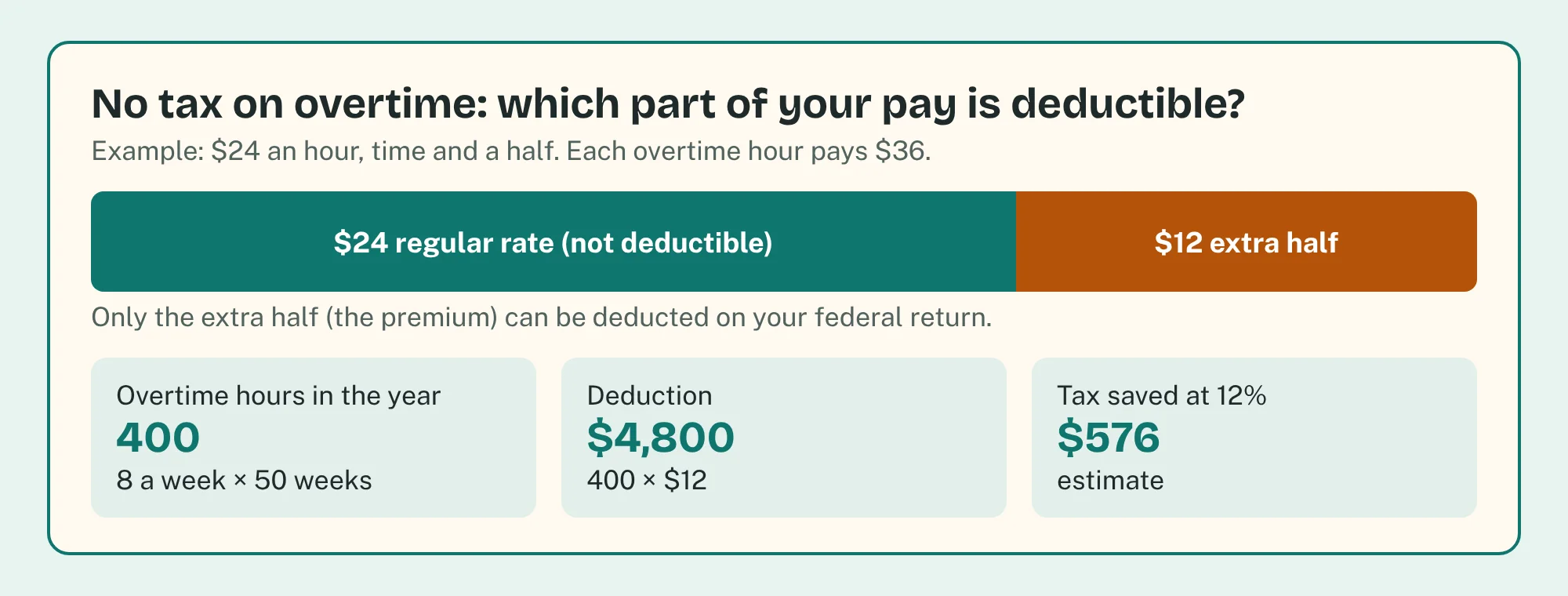
The part you can deduct is the extra half in time and a half, not the whole overtime hour. That is the question most people have, so here is a picture of it.
Why only the extra half counts
When you work overtime at time and a half, each hour has two parts. The first part is your normal rate. You would have earned it anyway. The second part is the extra half, the bonus for working overtime. The new rule only covers that extra half. The IRS says you may deduct the pay that goes above your regular rate (see the IRS page on the deduction).
So at $24 an hour, an overtime hour pays $36. Of that, $24 is your regular rate and $12 is the extra half. Over 400 overtime hours, the deductible amount is 400 × $12 = $4,800.
Who can use the deduction
- You need to be paid overtime. It is for non-exempt workers who earn overtime under the federal wage law. If you are salaried and exempt from overtime, there is nothing to deduct.
- You need a Social Security number that is valid for employment, issued before the return due date including extensions.
- If you are married, you must file jointly. Married people filing separately cannot claim it.
- You do not need to itemize. You can take the standard deduction and still claim it.
- People not covered by the FLSA get no qualified overtime, even if a union contract pays overtime. Owners with a 20% or greater share of the business are generally treated as exempt.
Not sure whether your pay counts as overtime? Check your hours with the overtime calculator or learn the basics in how to calculate overtime pay.
How much can you deduct?
There is a yearly limit, and higher earners lose part of it. The limit is $12,500 for a single person and $25,000 for a joint return. The deduction starts to shrink when your income goes above $150,000 (single) or $300,000 (joint). It goes down by $100 for every $1,000 above that line.
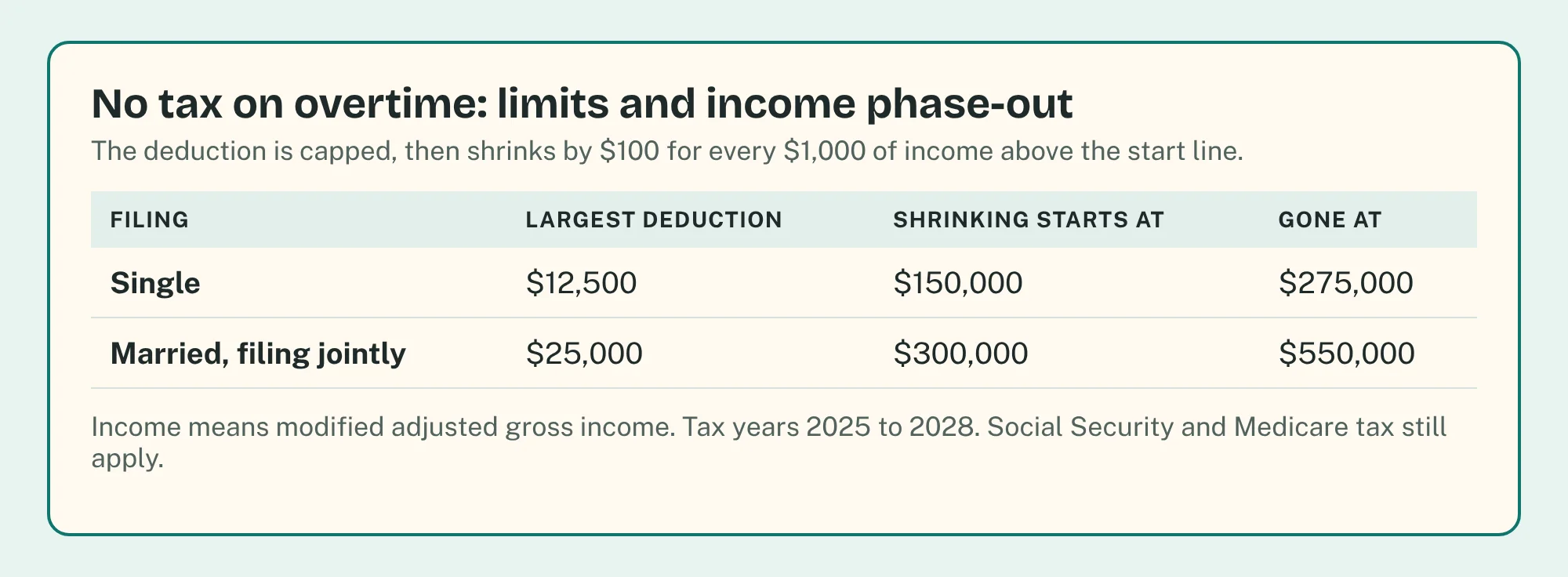
The income used here is called modified adjusted gross income, which is close to your total income after a few adjustments. Most hourly workers are far below these lines, so for them the limit is the only number that matters.
No tax on overtime calculator: estimate your deduction
Fill in the boxes for a quick estimate. It assumes your overtime is paid at time and a half, so the deductible part is half your hourly rate for each overtime hour.
This is an estimate, not tax advice. It does not check every IRS rule, such as which overtime counts. Use the IRS instructions or a tax professional to file.
The box uses your hourly rate. The IRS formula is FLSA overtime hours x one-half x your FLSA regular rate, which can include things like non-discretionary bonuses, so your real figure may differ.
Three worked examples
1. One worker, single. Earns $24 an hour and works 8 overtime hours a week for 50 weeks, so 400 hours. Deduction: 400 × $12 = $4,800. At a 12% tax rate, that saves about $576.
2. A married couple. She earns $30 an hour with 500 overtime hours: 500 × $15 = $7,500. He earns $28 an hour with 300 overtime hours: 300 × $14 = $4,200. Together that is $11,700, well under the $25,000 limit. At 12%, that saves about $1,404.
3. A higher earner. A single person with $200,000 of income and $12,000 of extra-half pay. Income is $50,000 over the $150,000 line, so the deduction is cut by 50 × $100 = $5,000. They can deduct $12,000 − $5,000 = $7,000.
When does no tax on overtime start and end?
It covers tax years 2025 through 2028. It applies from 1 January 2025, so overtime you worked in 2025 already counts. You claim it when you file your return, not through a special line on your paycheck. After 2028 it ends unless Congress extends it.
What it does not change
- Social Security and Medicare tax. They are still taken from your overtime pay in full.
- Your state tax. This is a federal deduction. State income tax rules are separate, so check your state tax agency.
- The overtime itself. Your employer still has to pay you time and a half for hours over 40 in the workweek.
How do you find your overtime amount?
For tax year 2025, employers did not have to report qualified overtime separately, so you may need to work the amount out yourself with the Schedule 1-A instructions. From tax year 2026, employers must report it on your W-2 (box 12, code TT), and you can only deduct what is shown there. If it is missing or too low, ask your employer for a corrected W-2 (Form W-2c). The time and a half calculator shows the extra half for any rate.
Keep your time cards. A saved record of hours from the time card calculator with lunch makes this much easier at tax time.
Withholding
Your employer cannot lower your withholding for this deduction unless you give a new Form W-4 (2026 W-4, step 4(b)). The IRS Tax Withholding Estimator accounts for it.
Common deduction mistakes
- Deducting the whole overtime pay instead of only the extra half.
- Counting double time or state-required overtime in full. Only the part that the federal wage law requires above your regular rate counts. If your employer pays double time, only the half portion needed to meet the federal rule is qualified (see the IRS questions and answers). IRS example: 50 hours at $20, with double time on 10 hours, is $400 paid for those 10 hours, but only $100 is qualified (the half-time part).
- Forgetting that Social Security and Medicare tax still apply.
- Filing separately when married, which rules the deduction out.
- Guessing your hours. Use your real time cards.
 Built and checked by Shehroz Shafiq, founder of TimeCardPal. Calculations are checked against hand-worked examples. Last updated 12 November 2026. About us
Frequently asked questions
Is overtime pay tax-free now?
No. Overtime is still taxed. The new rule lets you deduct the extra half of qualifying overtime pay from your federal taxable income, up to a limit.
How does no tax on overtime work?
You work out the extra-half part of your qualifying overtime, then deduct it when you file your federal tax return, up to $12,500 ($25,000 on a joint return).
When does no tax on overtime start?
It started on 1 January 2025 and runs through the 2028 tax year. You claim it on your return for each of those years.
Do I need to itemize to claim it?
No. You can take the standard deduction and still claim the overtime deduction.
Does it reduce Social Security and Medicare tax?
No. Those taxes still apply to your full overtime pay.
Does it apply to state taxes?
This is a federal deduction. State income tax rules are separate, so check your state tax agency.
Who cannot claim it?
People who are exempt from overtime, people without a valid Social Security number, and married people who file separately. Higher earners also lose part or all of it.
Does double time count?
Only in part. Qualified overtime is the pay above your regular rate that the federal wage law requires. If an employer pays double time, only the half portion needed to meet that requirement is qualified, according to the IRS questions and answers.
Where do I find my overtime amount for my return?
For tax year 2025, employers did not have to report it separately, so use the Schedule 1-A instructions to work it out. From tax year 2026, employers must report it on your W-2 (box 12, code TT).
What happens after 2028?
The deduction ends after the 2028 tax year unless Congress extends it.
Cite or link to this page
If this page helped your readers, you are welcome to link to it.
TimeCardPal. “No Tax on Overtime: How the New Deduction Works.” https://timecardpal.com/blog/no-tax-on-overtime/ (accessed 2026).