California Break Laws: Meal and Rest Breaks
California break laws give most employees a paid 10-minute rest break every 4 hours and an unpaid 30-minute lunch break after 5 hours. Here is how the rules work, shift by shift, and what happens if you miss a break.
- 4 min read
- Source: California DLSE
- Updated 18 November 2026
Key facts
- Rest breaks: paid, 10 minutes for every 4 hours worked or major part of 4 hours. None for 3.5 hours or less.
- Meal breaks: 30 minutes when you work over 5 hours, a second when you work over 10. Unpaid only if you are free of work.
- Missed break: one extra hour of pay at the regular rate for the day. It does not count toward overtime.
- Example: a 12-hour day has three rest breaks and two meal breaks.
- Source: California DLSE, rest periods and meal periods.
California break laws in short
California has some of the strictest break rules in the US. The rules come from the state Labor Code and the wage orders, and the California Division of Labor Standards Enforcement (DLSE) explains them in plain terms. In short:
- Rest breaks: a paid 10-minute break for every 4 hours worked, or major part of 4 hours.
- Meal breaks: an unpaid 30-minute break when you work more than 5 hours, and a second one when you work more than 10.
- If you miss one: your employer owes you one extra hour of pay for the day.
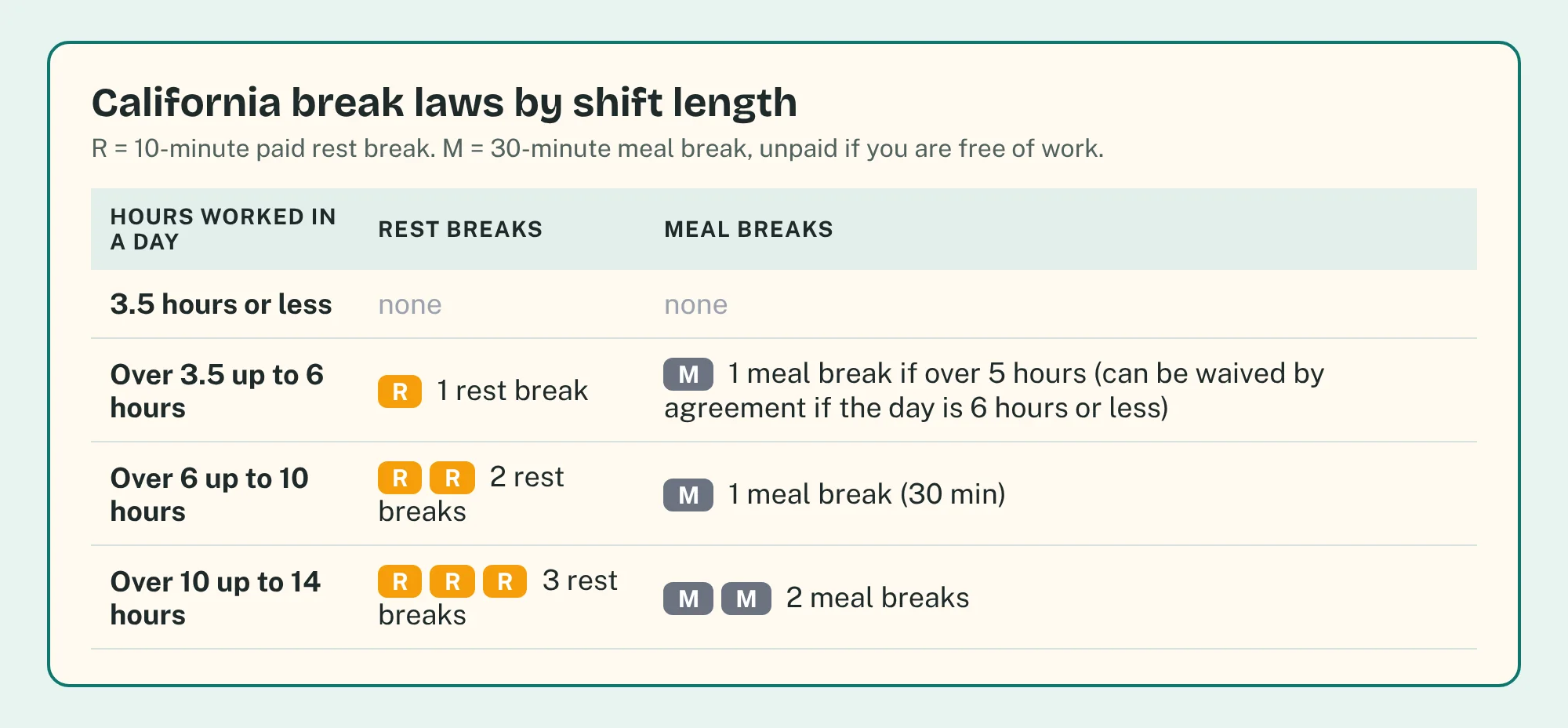
California rest break law: 10 minutes every 4 hours
This is the California 10-minute break law. Employers must give you a paid 10-minute rest break for every 4 hours you work, or major part of 4 hours. If you work 3.5 hours or less, no rest break is required. Rest breaks should fall near the middle of each 4-hour block when that is practical. Because they are paid, they count as hours worked and are never taken off your time card.
That means a 6-hour day gets one rest break, an 8-hour day gets two, and a 12-hour day gets three. Rest breaks are separate from the meal break.
California meal break law: 30 minutes when you work over 5 hours
This is the California lunch break law. If you work more than 5 hours in a day, your employer must give you a 30-minute meal break. You and your employer can agree to skip it if your day is no more than 6 hours. A second 30-minute meal break is required if you work more than 10 hours, and that one can be skipped by agreement if your day is 12 hours or less and you took the first.
- Unpaid: a meal break is unpaid only if you are free of all work during it.
- On duty: an on-duty meal break is allowed only when the job makes it impossible to be relieved, and there must be a written agreement. It is then paid.
- Stay on site: if your employer makes you stay at the worksite for lunch, that meal break must be paid.
For how to take an unpaid meal off your hours, use the time card calculator with lunch.
When must your break start, and who is covered?
Meal break start time. The first 30-minute meal break must start before the end of your fifth hour of work, so a lunch that begins after 5 hours of work is late. The second must start before the end of your tenth hour. A late meal break counts as a missed one for break pay. Your employer has to give you the chance to take a duty-free break, but it does not have to force you to take it (Brinker v. Superior Court, 2012).
Waiving a meal break. A waiver needs both you and your employer to agree. The first meal break can be waived only if your day is no more than 6 hours. The second can be waived only if your day is no more than 12 hours and you did not waive the first. Over 12 hours, both meal breaks are required. Rest breaks cannot be waived by agreement.
Who is covered. The meal and rest rules protect non-exempt employees, which means most hourly workers. Employees who are properly exempt as executive, administrative or professional staff are generally outside the wage-order break rules, and the extra-hour pay applies only where a wage order requires the break. A job title or a salary alone does not make someone exempt. Check with the Labor Commissioner if you are unsure.
What counts as a real meal break?
Many break problems come from one question: is it a real, duty-free break? In California it counts only if you are free from all work. Think of these common cases:
- Eating at your desk and answering calls. This is not a duty-free break. It is work time and must be paid.
- Told to stay at the worksite. If your employer makes you stay on site, the meal period must be paid.
- A written on-duty agreement. An on-duty meal is allowed only when the job makes it impossible to be relieved, such as a lone worker, and it needs a written agreement. That meal is paid.
- Nursing mothers. Employers must give reasonable break time to express milk, in a private place that is not a toilet stall. It runs at the same time as your normal breaks when possible, and any extra time is not required to be paid.
What if you do not get your break? Meal and rest break pay
If your employer does not give you a required meal period, it owes you one extra hour of pay at your regular rate for that day. The same applies to a missed rest break. According to the DLSE, this extra pay does not count toward overtime, and claims for it have a three-year time limit. If both a meal period and a rest break are missed on the same day, a California appeals court (United Parcel Service v. Superior Court, 2011) held that two extra hours are owed, one for each. Check your own case with the Labor Commissioner’s office or an employment lawyer.
Write down the days your breaks were missed and keep a copy. Then ask your supervisor or HR. If it is not fixed, you can contact the California Labor Commissioner’s office or an employment lawyer.
Final pay, pay stubs and how to file a wage claim
The extra hour of pay for a missed break is treated as wages, not a fine (Murphy v. Kenneth Cole, 2007). That is why the three-year limit applies. Since Naranjo v. Spectrum Security (2022), it also has to be paid on time when a job ends, and it should appear on your pay stub. If an employer willfully fails to pay it with your final pay, waiting time penalties can apply under Labor Code 203, up to 30 days of wages.
To file a claim, you complete the Labor Commissioner’s Initial Report or Claim (DLSE Form 1). It can be filed online, by email, by mail or in person. If your hours varied from week to week and you claim missed breaks, DLSE also uses Form 55 to list the days. Bring your pay stubs, your time records and your own notes of the missed breaks. You can also bring a lawsuit in court instead of a DLSE claim.
Rules for exemptions and final pay change, so confirm the current rules with the Labor Commissioner’s wage claim page.
Break pay example: what a missed lunch is worth
Say you earn $22 an hour and work 8:00 AM to 4:30 PM with a 30-minute unpaid lunch. You are paid for 8 hours, which is $176. Your two paid 10-minute rest breaks are already inside those 8 hours.
Now say your employer never let you take the lunch and you worked straight through. You worked 8.5 hours and should be paid for all of it. On top of that, the employer owes one extra hour at your regular rate for the missed meal period, which is another $22. That extra hour does not count toward overtime. To count your paid hours on a normal day, use the time card calculator with lunch.
Break laws and overtime in California
California also pays overtime by the day, not only by the week. Breaks affect your hours because unpaid meal breaks come off, and paid rest breaks stay in. See the California overtime calculator for daily overtime and double time. For other states, check your state labor department.
TimeCardPal gives general information and estimates, not legal, tax or payroll advice. California break rules have exceptions for some jobs, industries and union contracts, and they change. Check with the California Labor Commissioner or an employment lawyer for your situation.
 Built and checked by Shehroz Shafiq, founder of TimeCardPal. Calculations are checked against hand-worked examples. Last updated 18 November 2026. About us
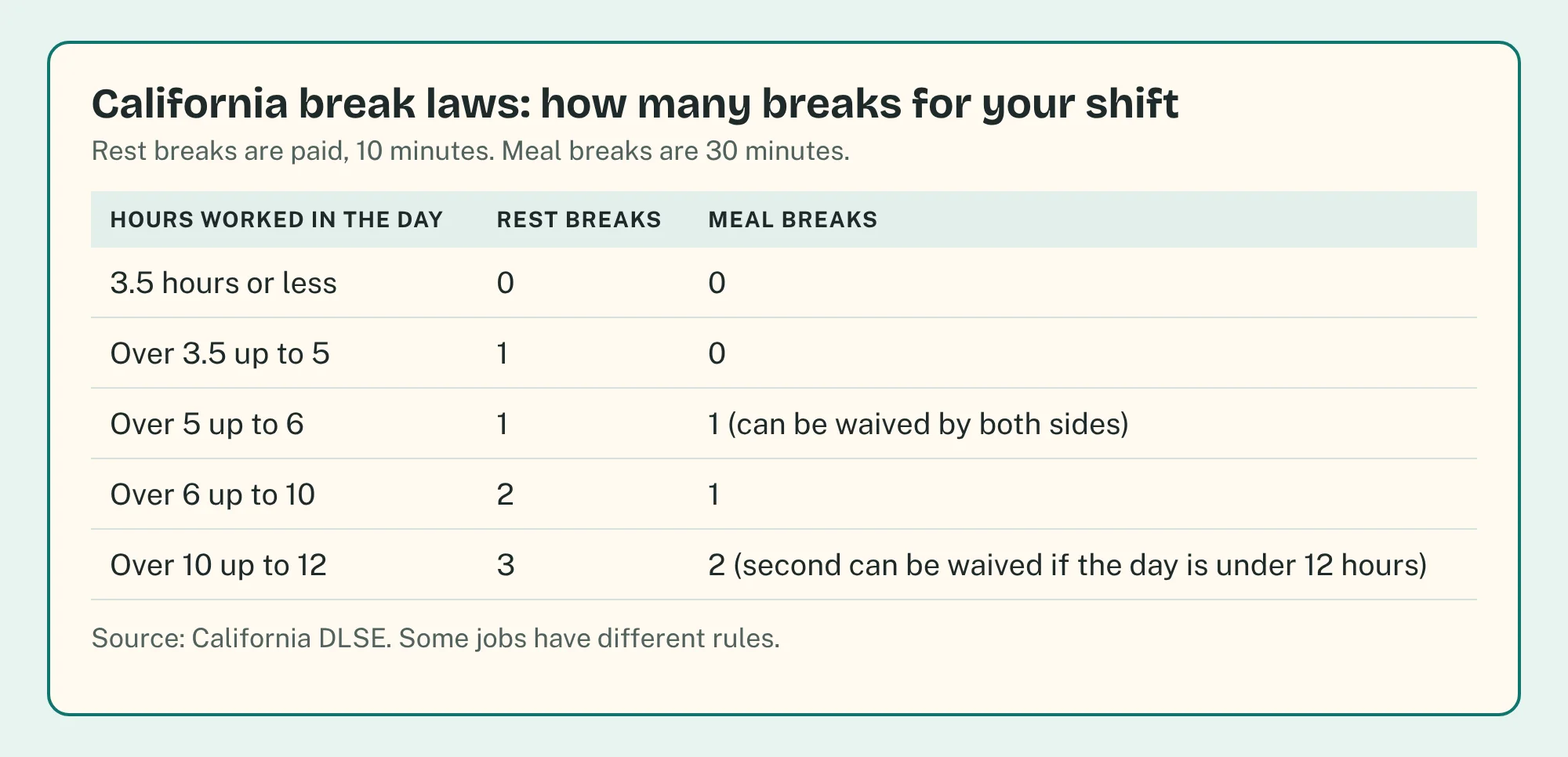
Your breaks at a glance
Find your hours in the chart. A rest break is 10 minutes and is paid. A meal break is 30 minutes. If your day is over 5 hours, the first meal break applies. A second one comes once you pass 10 hours. Some of these can be waived by agreement, as the chart notes.
Break rules people get wrong
- Treating rest breaks as unpaid. They are paid time.
- Assuming lunch is always unpaid. If your employer makes you stay at the worksite, that time is paid.
- Waiving a meal break by yourself. A waiver needs both sides to agree, and only when the day is short enough.
- Missing the extra pay. A missed break can mean one extra hour of pay for that day. Keep a record of what happened.
This is general information, not legal advice. Jobs and agreements can change the rules.
Frequently asked questions
What are the break laws in California?
California requires a paid 10-minute rest break for every 4 hours worked, or major part of 4 hours, and an unpaid 30-minute meal break if you work more than 5 hours. A second meal break is required if you work more than 10 hours. Some jobs and agreements have different rules.
How long is a lunch break in California?
A meal break is 30 minutes. It starts for work periods over 5 hours. It is unpaid only if you are free of all work during it. If you must stay on duty, it must be paid.
Do you get paid for your 10-minute breaks in California?
Yes. Rest breaks are paid time. They count as hours worked, so nothing is taken off your time card for them.
What if my employer does not give me my break?
The employer owes one extra hour of pay at your regular rate for the day for a missed meal period, and the same for a missed rest break. This extra pay does not count toward overtime. Claims for it have a three-year time limit, according to the DLSE.
Can I skip my lunch in California?
You and your employer can agree to skip the meal break only if your workday is 6 hours or less. For a second meal break, both sides can agree to skip it if the day is 12 hours or less and the first one was taken.
How many breaks in a 12-hour shift in California?
Under the 4-hour rule, a 12-hour shift has three 10-minute rest breaks and two 30-minute meal breaks. The second meal break can be waived by agreement if the day is 12 hours or less, and only if the first meal break was not waived.
Do I get a lunch break on a 5-hour or 6-hour shift in California?
At exactly 5 hours, no meal break is required, because the rule starts when you work more than 5 hours. On a shift of more than 5 and up to 6 hours, you get a meal break, but you and your employer can agree to skip it.
Do I get paid if I work through my lunch?
Yes. If you are not free of all duty, the meal break is work time and must be paid. If your employer required you to work through it and did not give you the break, it also owes one extra hour of pay for that day.
How long do I have to make a claim for a missed break?
The DLSE says claims for meal and rest break violations have a three-year time limit.
How many rest breaks do I get on a 6-hour day in California?
A 6-hour day falls in the over 3.5 up to 6 group, so you get one paid 10-minute rest break. After 6 hours you move to two.
How many meal breaks do I get on a 12-hour day?
A day of more than 10 hours includes two meal breaks. The second can be waived only if the day is 12 hours or less, the first meal break was taken, and both sides agree.
When does my lunch break have to start in California?
Before the end of your fifth hour of work. If you start at 8:00 AM, lunch has to begin before 1:00 PM. The second meal break on a day over 10 hours has to start before the end of the tenth hour.
Do California break laws apply to exempt employees?
The meal and rest rules are written for non-exempt employees. Properly exempt executive, administrative and professional employees are generally outside the wage-order rules, and the extra-hour pay applies only where a wage order requires the break. Misclassified workers are often non-exempt, so the Labor Commissioner looks at the actual duties.
How do I file a wage claim for missed breaks in California?
File the Initial Report or Claim (DLSE Form 1) with the Labor Commissioner, online, by email, by mail or in person. If your hours varied, DLSE also uses Form 55 to list missed meal and rest breaks. Attach pay stubs and your notes.
Can I get waiting time penalties for unpaid break pay?
Yes, in some cases. Under Naranjo v. Spectrum Security (2022), unpaid break pay counts as wages. If an employer willfully fails to pay it with final pay after a job ends, waiting time penalties of up to 30 days of wages can apply under Labor Code 203.
Does my employer have to make me take my break?
No. Under Brinker (2012), the employer must give you a real chance to take a duty-free meal break but does not have to make sure you take it. If it pressures you to work through it, that counts as not providing the break.
Cite or link to this page
If this page helped your readers, you are welcome to link to it.
TimeCardPal. “California Break Laws: Meal and Rest Breaks.” https://timecardpal.com/blog/california-break-laws/ (accessed 2026).