How Many Hours Can You Work in a Day?
How many hours can you work in a day? For most adults in the US there is no legal limit, but hours over 40 in a week must be paid as overtime. Here is the rule, what counts as work time, and what long days pay.
- 5 min read
- Source: US Dept. of Labor
- Updated 18 November 2026
Key facts
- Federal law: no limit on hours per day or week for workers aged 16 and over.
- Overtime pay: 1.5 times the regular rate for hours over 40 in a workweek, for most hourly workers.
- Example: five 10-hour days at $20 an hour = 40 × $20 + 10 × $30 = $1,100.
- Limits can come from: state daily overtime rules, union or employment contracts, and certain jobs such as driving.
- Source: US Department of Labor, Fact Sheet #22 and #23.
Is there a legal limit on daily hours?
For most adults, there is no legal limit on how many hours you can work in a day. Federal law does not cap daily hours. It only sets a pay rule. Here is what applies:
- Federal law: no daily or weekly limit on hours for workers aged 16 and over, according to the US Department of Labor (Fact Sheet #23).
- Overtime pay: most hourly workers get 1.5 times their regular rate for hours over 40 in a workweek.
- State laws: some states add daily overtime. California pays overtime after 8 hours in a day.
- Certain jobs: drivers, pilots and some health care workers have their own limits or rest rules.
How many hours can you work in a day, and in a week?
So how many hours straight can you legally work in a day? In most cases, as many as your employer schedules, as long as you are paid correctly. The pay rule counts hours in a workweek, not in a day. Here is what long days add up to over a five-day week at $20 an hour:
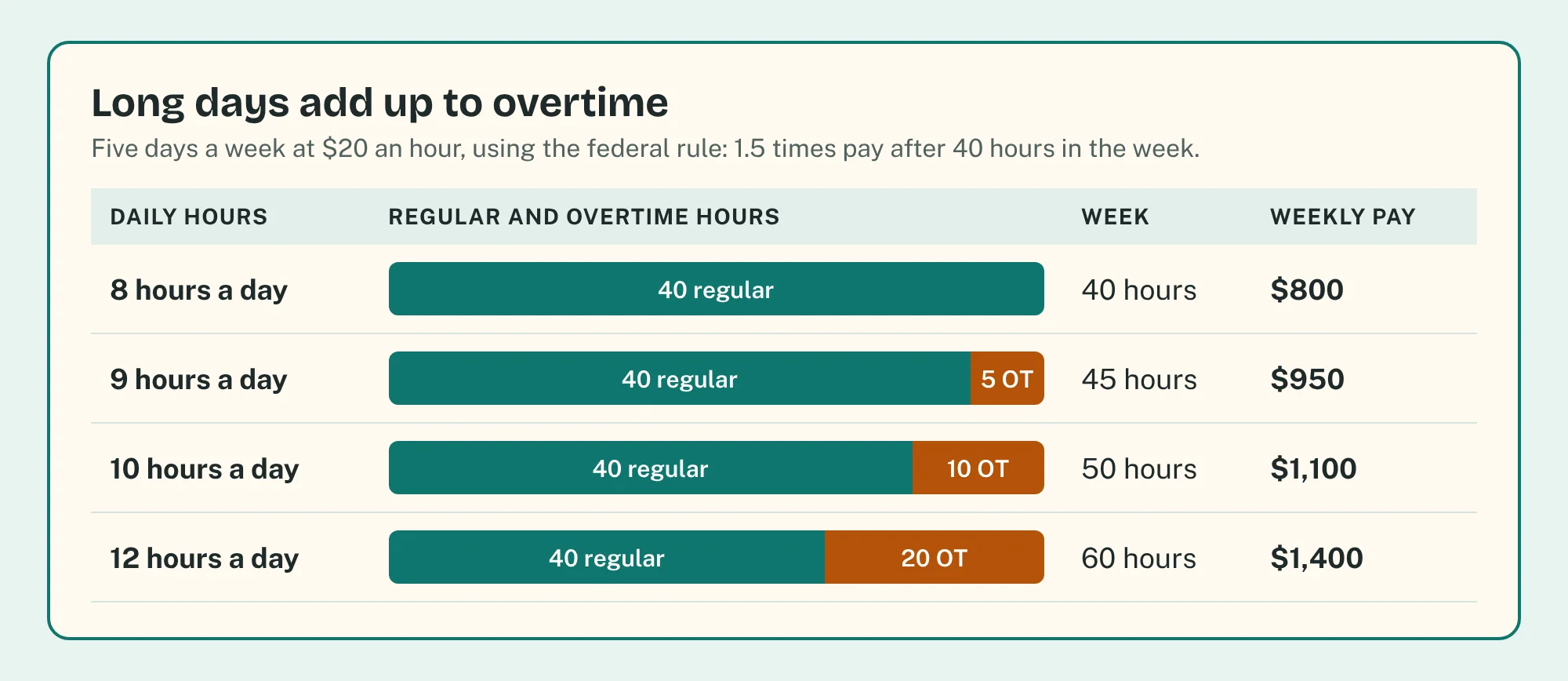
Two 12-hour days do not become overtime by themselves. It is the week that counts. If you work 12 hours on three days and stay home the rest of the week, that is 36 hours, with no federal overtime. Try your own week in the overtime calculator.
What counts as hours worked
Long days are easier to measure if you know what counts. According to DOL Fact Sheet #22:
- Waiting: time spent waiting to do work counts if you are “engaged to wait.” Time spent waiting to be given a job does not.
- On call: counts if you must stay at your employer’s premises. It usually does not count if you are on call at home and can go about your day.
- Travel: your normal commute does not count. Travel between job sites during the day does.
- Training: counts unless it is outside normal hours, voluntary, not job-related and you do no other work.
- Breaks: short rest breaks (about 20 minutes or less) are paid. A meal period of 30 minutes or more does not count if you are fully relieved of duty.
To total your own day, use the work hours calculator, or the time card calculator with lunch if you take an unpaid break.
A week of 12-hour shifts, worked out
Many people ask about 12-hour shifts because they are common in hospitals, factories and warehouses. At $20 an hour, here is how the pay changes:
- Three 12-hour shifts = 36 hours. No overtime, so $720.
- Four 12-hour shifts = 48 hours. The first 40 hours pay $800, and the 8 extra hours pay 8 × $30 = $240. Total $1,040.
The week is what counts under federal law. A workweek is a fixed period of 168 hours, or seven 24-hour days in a row, and your employer picks the start. California also counts overtime by the day, so its numbers differ. Check yours in the weekly hours calculator.
Long shifts also raise a pay question about sleep. On a shift under 24 hours, any sleep or rest while on duty counts as work time. Only on shifts of 24 hours or more can a regular sleep period of up to 8 hours be left out, and only under certain conditions (DOL Fact Sheet #22).
Can your employer make you work long days?
This is the mandatory overtime question. For most adults, yes. Federal law lets an employer require overtime, but most hourly workers must be paid 1.5 times their rate for hours over 40 in the week, and that right cannot be waived by agreement (Fact Sheet #23). Limits can come from:
- a union contract or your own employment contract,
- a state law for certain jobs, for example some health care workers,
- your state’s break rules, which can require meal and rest breaks on long days.
If you are asked to work a very long day, ask about the pay in writing, and make sure every hour goes on your time card.
Jobs with real limits on long hours
The general rule has important exceptions. A few jobs have limits set by law:
- Truck drivers. The Federal Motor Carrier Safety Administration lets property-carrying drivers drive up to 11 hours after 10 hours off duty, only within a 14-hour window. A 30-minute break is required after 8 hours of driving, and driving is capped at 60 hours in 7 days or 70 in 8 days.
- Nurses. Some states limit mandatory overtime for nurses, usually allowing it only in emergencies. Texas, Illinois, Massachusetts, Maine and New Hampshire are examples with a state law on it. Rules differ by state and by employer type, so check your state labor or health department.
- Workers under 16. Child labor rules limit hours by age and by school days.
Anyone else is usually limited only by their contract and by what they agree to.
Fair Labor Standards Act: exempt and non-exempt workers on long days
The Fair Labor Standards Act (FLSA) is the federal wage law, and it treats workers in two groups. Non-exempt employees, which includes most hourly workers, must be paid at least 1.5 times their regular rate for hours over 40 in a workweek. Exempt employees, such as many salaried managers and professionals, are specifically excluded from that overtime rule (see DOL Fact Sheet #23).
For daily hours this means little changes by group: neither group has a federal cap on hours in a day. The difference is pay. A non-exempt worker on a 12-hour day adds to the week's overtime count, while an exempt worker is paid the same salary however long the day runs. Whether you are exempt depends on your pay and your duties, not your job title. For the double time side of this, see double time pay.
Long hours, fatigue and safety
No federal law stops most adults from working a long day, but the risk is real. OSHA notes that extended shifts, meaning more than 8 hours, and long work hours may increase the risk of injuries and accidents and can contribute to worker fatigue (OSHA, worker fatigue). A NIOSH review of 52 studies found that the 9th to 12th hours of work were linked to lower alertness, more fatigue and more injuries in the studies that looked at extended shifts (NIOSH Publication 2004-143).
That is why safety-critical jobs set their own limits, such as the driving and rest rules above. If your own schedule often runs past 10 or 12 hours, keep a record of the hours so you can check pay and rest against what you actually worked.
Breaks on a long day
Federal law does not require breaks for adults, but many states do, and the rules grow with the length of the day. For a 12-hour day in California, for instance, the law calls for three rest breaks and two meal breaks. See California break laws. Other states have their own rules, so check your state labor department.
Working an overnight or 12-hour shift? Check the shift hours guide, and use the time clock calculator to count hours across midnight. Add up the week with the weekly hours calculator.
TimeCardPal gives general information and estimates, not legal, tax or payroll advice. Hours and overtime rules vary by state, job and contract. Check with your state labor department or an employment lawyer for your situation.
 Built and checked by Shehroz Shafiq, founder of TimeCardPal. Calculations are checked against hand-worked examples. Last updated 18 November 2026. About us
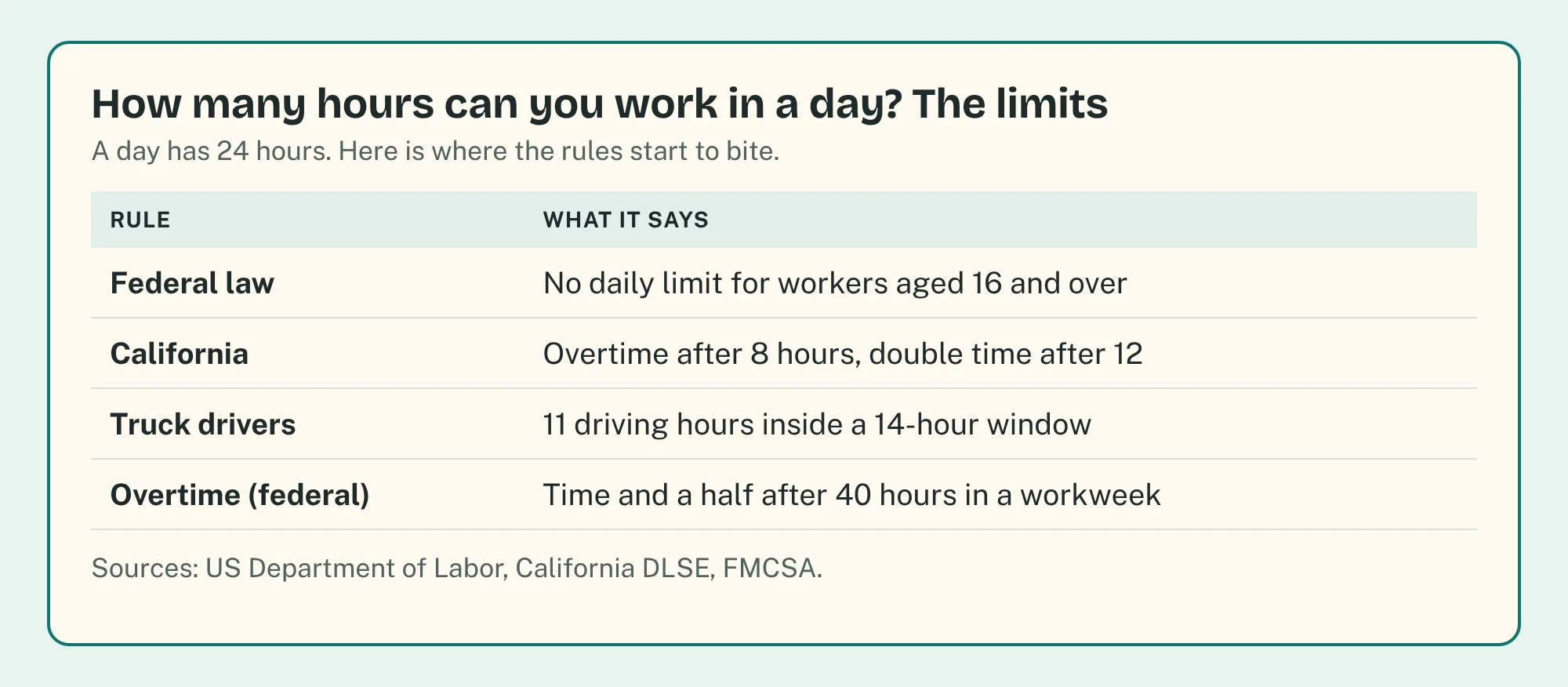
The rules in one picture
The picture sums it up. Federal law does not stop most adults from working long days, but pay rules and job rules do. California pays overtime after 8 hours and double time after 12. Truck drivers have a firm cap of 11 driving hours.
Common mix-ups
- “No limit” does not mean no extra pay. Overtime pay can still apply after 40 hours in a week, and in some states after a certain number of hours a day.
- Mixing up driving hours and work hours. A truck driver can work more hours than they drive, but the driving cap still applies.
- Forgetting age. The federal no-limit rule is for workers aged 16 and over. Younger workers have limits.
- Forgetting rest. A long day is easier to survive with the breaks your state requires.
Frequently asked questions
How many hours can you work in a day legally?
For most adults in the US, there is no federal limit on hours per day. Federal law only requires overtime pay for hours over 40 in a workweek. Some states add daily overtime, and some jobs, such as driving or health care, have their own limits.
How many hours straight can you legally work in a day?
There is no general federal limit for adults, so an employer can often schedule a very long day. Rules for meal and rest breaks may apply in your state. Drivers, pilots and some other jobs have their own rest rules.
How many hours can you work in a week?
There is no federal weekly cap for workers aged 16 and over. Hours over 40 in a workweek must be paid at 1.5 times the regular rate for most hourly workers.
Is mandatory overtime legal?
In most cases yes. Federal law lets employers require overtime for adults, but it must be paid for most hourly workers. A union contract, an employment contract or a state law for certain jobs, such as some health care workers, can add limits.
Do breaks count toward the hours I work in a day?
Short breaks of about 20 minutes or less count as paid work time. A meal period of 30 minutes or more generally does not count if you are completely free of work.
How many hours can a minor work in a day?
Workers under 16 have separate hour limits under child labor rules, and the limits depend on age and whether school is in session. Check the US Department of Labor or your state labor office.
Can an employer make you work 16 hours in a day?
Federal law does not set a daily limit for adults, so it can be legal. Hours over 40 in the week must be paid as overtime. Some jobs, such as truck driving, have strict limits, and state laws or contracts can add rules.
How many days in a row can you work?
Federal law has no limit on the number of days in a row for adults. California counts the seventh day in a row in its overtime rules. Other states may have day-of-rest laws, so check your state labor office.
Do I get paid for working past the end of my shift?
Yes. Work your employer knows about or allows must be paid, even if it was not requested. Write down the real start and end time each day.
Does a long workday mean I get overtime?
Under federal law, overtime is based on the week, after 40 hours. Some states, like California, also pay overtime by the day.
Is there a limit for workers under 16?
Yes. Workers under 16 have limits on hours. The no-limit rule applies to workers aged 16 and over.
Can an exempt employee be made to work unlimited hours?
Federal law sets no daily or weekly cap for adults, exempt or not, and exempt employees get no federal overtime. A contract, company policy or state rule can still limit hours or require extra pay, so check yours.
Are long work hours bad for your health and safety?
Research reviewed by OSHA and NIOSH links long work hours and extended shifts to more fatigue, lower alertness and a higher risk of injuries. The risk is not a legal limit, but it is why some jobs cap hours.
Cite or link to this page
If this page helped your readers, you are welcome to link to it.
TimeCardPal. “How Many Hours Can You Work in a Day?.” https://timecardpal.com/blog/how-many-hours-can-you-work-in-a-day/ (accessed 2026).