Double Time Pay: What It Is and When You Get It
Double time pay means two times your regular rate. It is not a federal rule, but it applies in California and in some contracts. Here is when it applies, how to work it out, and whether holidays pay double.
- 5 min read
- Source: DOL and California DLSE
- Updated 18 November 2026
Key facts
- Double time means 2 times your regular rate. At $20 an hour, that is $40.
- Federal law does not require double time or holiday pay.
- California: double time after 12 hours in a day, and after 8 hours on the seventh day in a row.
- Example: a 14-hour day at $20 an hour = $160 + $120 + $80 = $360.
- Sources: US Department of Labor, and the California DLSE overtime worksheet.
What is double time pay?
Double time pay is simple: you earn two times your normal hourly rate for certain hours. If you earn $20 an hour, that rate is $40 an hour. That is more than regular overtime, which is usually time and a half, or $30 an hour.
Here is the part that surprises many people. It is not a national rule. It only applies if your state, your union contract, or your employer says so.
- Federal law: no 2x rate required.
- California: the 2x rate is required in two cases, shown below.
- Other places: only when a contract or company policy promises it.
Is double time required by law?
Not under federal law. The US Department of Labor says the federal law has no requirement for double time pay, and that holiday and weekend extras are matters between you and your employer. What federal law does require, for most hourly workers, is time and a half for hours over 40 in a workweek. You can work that out in the overtime calculator.
So if your boss offers double pay on a holiday or a night shift, that is a bonus rate, not a legal right. It is worth getting in writing.
When do you get double time in California?
California is the best known case. According to the California DLSE overtime worksheet, double time is owed in two cases:
- Over 12 hours in a workday. Hours past the 12th are paid at 2 times your rate.
- Over 8 hours on the seventh day in a row. If you work seven days in a row in the same workweek, hours past 8 on that seventh day are double time.
Between 8 and 12 hours in a day, California pays time and a half. There are exceptions for some jobs, such as farm work, and for approved alternative workweeks. Here is a worked day:
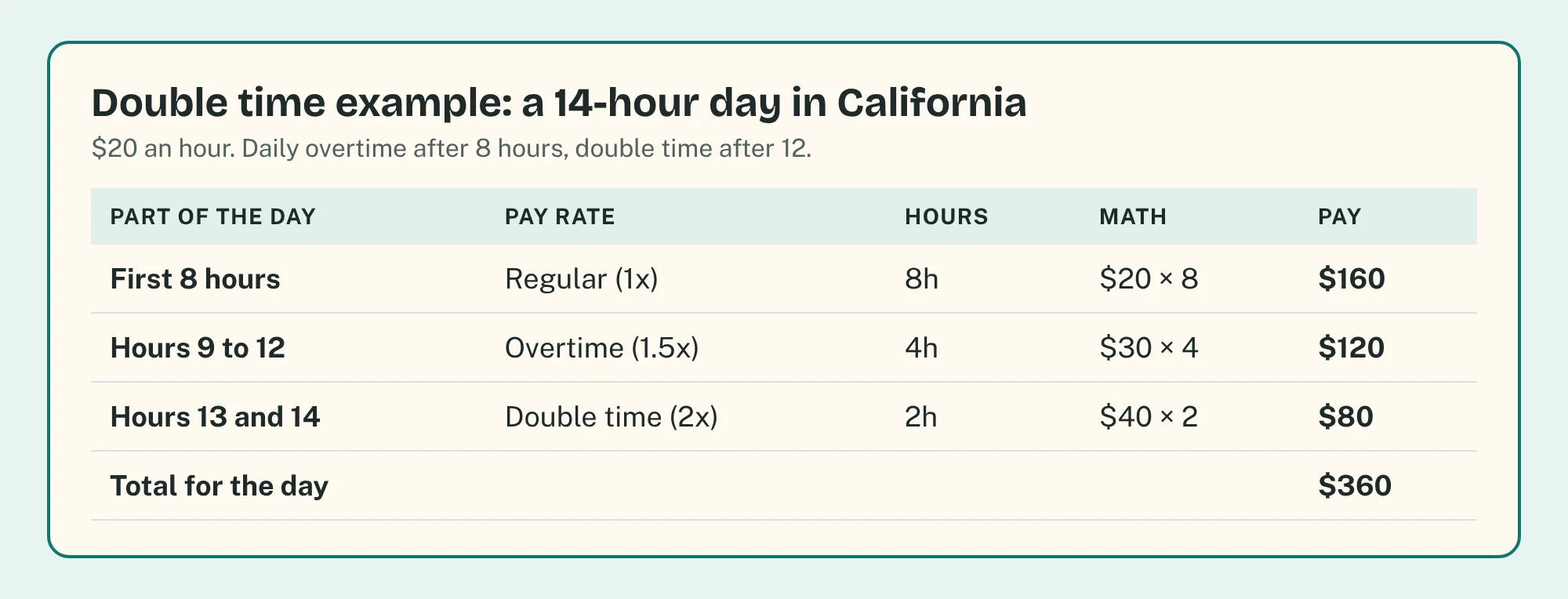
For your own numbers, use the California overtime calculator. It splits regular, overtime and 2x hours for you.
How to calculate double time pay
You only need three steps:
- Find your regular rate, for example $18 an hour.
- Multiply it by 2 to get the 2x rate: $18 × 2 = $36.
- Multiply by the hours that qualify. Three hours is $36 × 3 = $108.
Then add the regular and overtime hours worked that day or week. If you want the time and a half part explained in detail, see how to calculate overtime pay.
Double time examples: seventh day, long day and holiday
Here are three examples:
- The seventh day in a row in California, 10 hours at $25: the first 8 hours are time and a half, 8 × $37.50 = $300. The last 2 hours are double time, 2 × $50 = $100. Total $400.
- A 13-hour day in California at $18: 8 × $18 = $144, plus 4 hours of overtime at $27 = $108, plus 1 hour at $36. Total $288.
- A holiday at $20 an hour where your company pays double time: 8 hours × $40 = $320.
Quick rates at other pay levels: $15 an hour doubles to $30, and $25 an hour doubles to $50. It is a rate, so it only matters for the hours that qualify.
Is holiday, weekend or night work double time?
Usually not, and not by law. Many employers do pay time and a half or double time on holidays as a perk, or because a union contract says so. If you are told “holidays are double time,” ask where it is written down, such as your offer letter or the employee handbook.
The US Department of Labor says the federal law does not require extra pay for weekend or night work, and it does not require holiday pay. Any higher rate comes from your contract, your union, your company policy, or state law.
If you are promised a higher rate, ask for it in your offer letter or in the handbook. Then check your pay stub. The line should show the hours at each rate: regular, time and a half, and double time.
If the pay looks short, write down your dates and hours, ask your payroll team to explain it, and keep a copy. If it is not fixed, contact your state labor office or the US Department of Labor Wage and Hour Division.
Double time vs time and a half
- Time and a half: 1.5 times your rate. The federal rule for hours over 40 in a week. See the time and a half calculator.
- Double time: 2 times your rate. Only where a state law, contract or policy says so.
At $20 an hour: time and a half is $30, and double time is $40. Over a very long day the gap adds up, which is why the hours you can work in a day matters too.
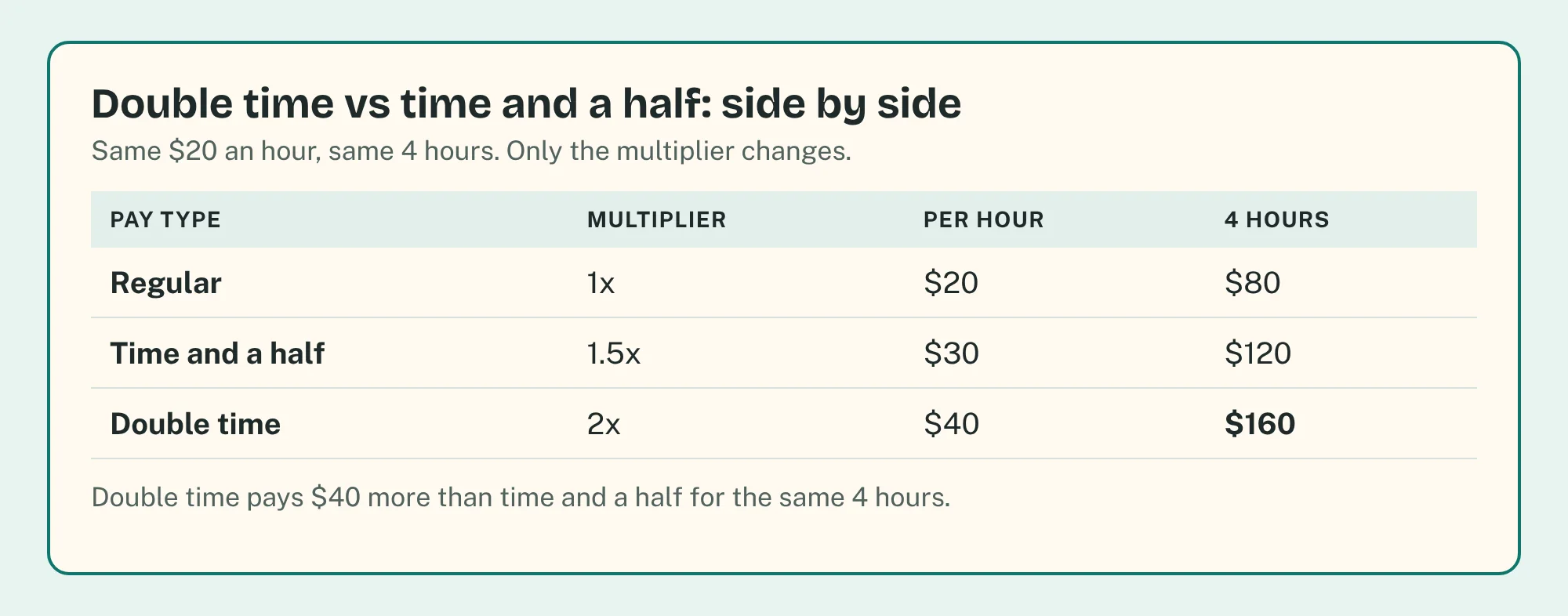
The picture shows the difference: four hours paid at time and a half come to $120, and the same four hours at double time come to $160, which is $40 more.
TimeCardPal gives general information and estimates, not legal, tax or payroll advice. Rules differ by state, job and contract. Check with your state labor office or an employment lawyer for your situation.
 Built and checked by Shehroz Shafiq, founder of TimeCardPal. Calculations are checked against hand-worked examples. Last updated 18 November 2026. About us
Who gets double time: exempt, non-exempt and union employees
The Fair Labor Standards Act (FLSA) is the federal law behind overtime. It covers non-exempt employees, who must be paid at least time and a half for hours over 40 in a workweek. Exempt employees, such as many salaried managers and professionals, are not covered by that overtime rule, so federal law gives them no overtime and no double time. Whether you are exempt depends on your pay and your duties, not your job title.
Where double time exists, it usually comes from one of three places: a state law (California is the main example), a collective bargaining agreement, which is a union contract, or your employer's own pay policy. A union contract can promise double time for holidays, weekends or very long shifts even though the law does not.
Double time vs shift differentials and straight time
Double time is a premium rate that applies to certain hours. A shift differential is a different thing: extra pay for working evenings, nights or weekends, set as a flat amount or a percentage by your employer. Straight time is simply your regular hourly rate with no premium on top. A pay stub can show all three, so check which line your extra hours fall under.
Mistakes people make with double time
- Thinking the law requires it everywhere. Federal law has no 2x rule, so it comes from your state, contract or employer.
- Paying double time on the whole day. In California only the hours past the line get the 2x rate, such as hours over 12.
- Forgetting the seventh day. In California, hours over 8 on the seventh day in a row are double time, while the first 8 are time and a half.
- Mixing up the rates. Double time is 2 times your rate. Time and a half is 1.5 times.
Frequently asked questions
What is double time pay?
Double time pay means you are paid two times your regular hourly rate for certain hours. At $20 an hour, double time is $40 an hour.
Is double time required by federal law?
No. The US Department of Labor says the federal law has no requirement for double time pay. It is a matter of agreement between you and your employer, or of state law or a union contract.
When do you get double time in California?
In California, double time is owed for hours over 12 in a workday, and for hours over 8 on the seventh day in a row worked in the same workweek. Some jobs and agreements have exceptions.
Is holiday pay double time?
Not by federal law. The federal law does not require holiday pay or a higher rate for holidays. Some employers choose to pay double time on holidays, so check your pay policy or contract.
How do I work out double time pay?
Multiply your regular hourly rate by 2, then multiply by the double time hours. For example, $18 an hour for 3 double time hours is $18 x 2 x 3 = $108.
Is double time the same as overtime?
Overtime usually means time and a half, which is 1.5 times your rate. Double time is a higher rate, 2 times your rate. Double time can start after overtime has already started, as it does in California.
Do you get double time on weekends or at night?
Not by federal law. The US Department of Labor says the federal law does not require extra pay for weekend or night work. Some employers or contracts pay a higher rate anyway.
Can an employer refuse to pay double time?
If double time is promised in your contract, union agreement or company policy, or required by your state, the employer must pay it. If it is only a favor with nothing in writing, there may be no right to it.
How much is double time at $15, $20 and $25 an hour?
Double time is $30, $40 and $50 an hour. Time and a half would be $22.50, $30 and $37.50.
How much more is double time than time and a half?
Double time is half your hourly rate more per hour. At $20 an hour, that is $40 against $30, so $10 more every hour.
Do exempt employees get double time?
Not under federal law. Exempt employees are not covered by the FLSA overtime rule, so they get no overtime or double time unless a contract, company policy or state law says otherwise.
Can a union contract require double time?
Yes. A collective bargaining agreement can promise double time for holidays, weekends or long shifts, even though federal law does not. Check the contract for the exact hours that qualify.
What is the difference between double time and a shift differential?
Double time pays 2 times your regular rate for qualifying hours. A shift differential is extra pay, as a flat amount or percentage, for working evening, night or weekend shifts. Your employer sets it; no federal law requires it.
Cite or link to this page
If this page helped your readers, you are welcome to link to it.
TimeCardPal. “Double Time Pay: What It Is and When You Get It.” https://timecardpal.com/blog/double-time-pay/ (accessed 2026).