How Many Hours Is Part Time?
How many hours is part time? There is no federal rule. The US government counts under 35 hours a week as part time, and health coverage rules draw the line at 30. Here are the numbers per day, week, month and year, with pay examples.
- 9 min read
- Sources: DOL, BLS, IRS
- Updated 12 November 2026
Key facts
- Usual line: under 35 hours a week. The US Bureau of Labor Statistics (BLS) counts 1 to 34 hours as part time.
- Under 30 hours: part time on every common yardstick. 20 hours a week is 4 hours a day, about 87 hours a month.
- 30 to 34 hours: the grey zone. Part time for the BLS, but full time for ACA health coverage at large employers.
- No federal definition: the Department of Labor says the FLSA “does not define full-time employment or part-time employment”. Your employer sets it.
- Still covered: part-timers get the minimum wage and overtime pay over 40 hours a week, like everyone else.
- Sources: US Department of Labor, BLS, IRS.
Part-time hours: the short answer
Part time means working fewer hours than your employer’s full-time line. In the US that usually means less than 35 hours a week. Most part-time jobs fall between 15 and 29 hours. Here is how the main yardsticks compare:
- BLS (government statistics): anyone who usually works 1 to 34 hours a week is part time.
- ACA (health coverage law): an employee who averages 30 or more hours a week counts as full time for large employers.
- Your employer: the contract or handbook decides pay grade, benefits and schedule. Some employers call 32 hours full time, and some say 40.
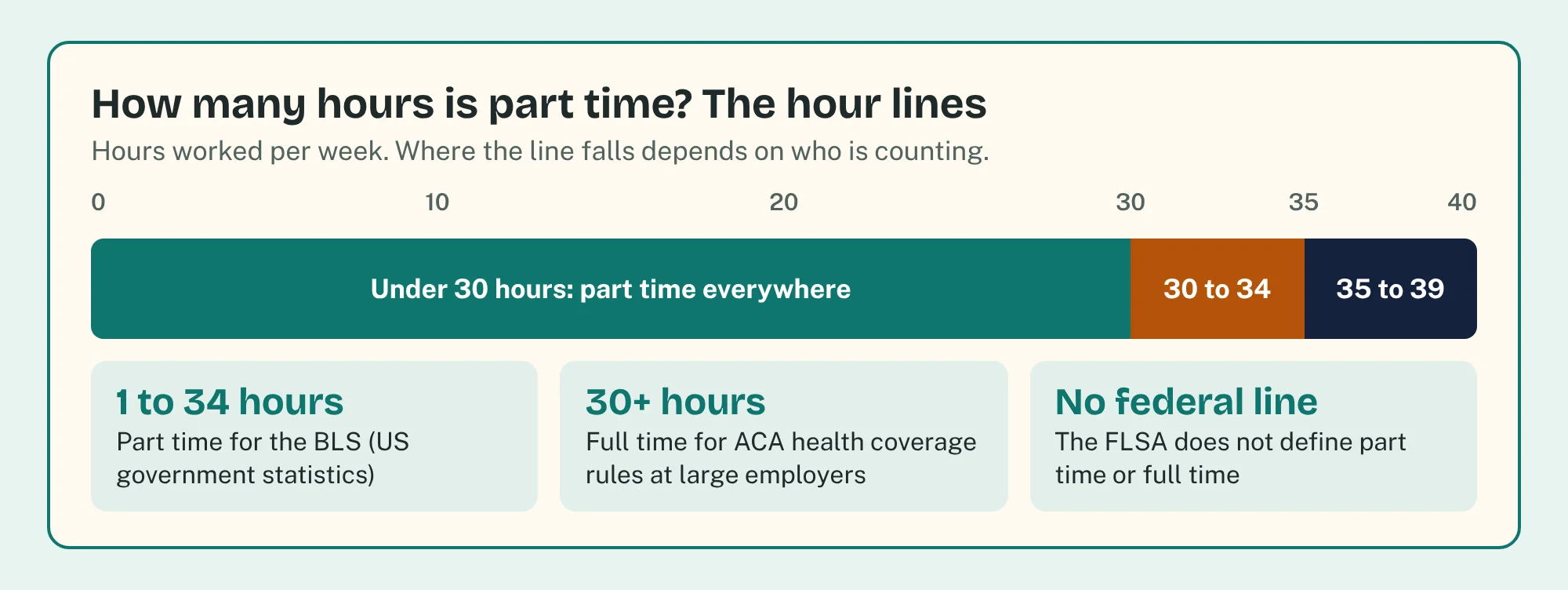
So if you work under 30 hours a week, you are part time everywhere. Between 30 and 34 hours, check which rule you mean. At 35 hours and above, you are full time for most statistics. For the full-time side, see how many hours is full time.
Is there a legal definition of part time?
Not in federal labor law. The Department of Labor says the Fair Labor Standards Act (FLSA) does not define full-time or part-time work, that it is generally for the employer to decide, and that the label does not change how the FLSA applies (DOL). In practice, three things draw lines:
- Your employer. A company may say part time is under 30, under 32 or under 35 hours. It can put this in the handbook or your offer letter.
- The BLS. For national statistics, 1 to 34 hours a week is part time. In 2025, BLS data show people working part time averaged about 21 to 23 hours a week (BLS table).
- The Affordable Care Act. The IRS treats an employee as full time if they average at least 30 hours of service a week, or 130 hours in a month. Employers with 50 or more full-time equivalent employees must offer them health coverage (IRS).
Some states and cities add their own rules, for example on paid sick leave or predictable schedules. Check your state labor department for yours.
Part-time hours per day, week, month and year
Here is what common part-time weeks add up to. The table assumes a five-day week and 52 weeks a year. Pay uses an example rate of $15 an hour, so swap in your own.
| Hours a week | Hours a day (5 days) | Hours a month | Hours a year | Pay a week at $15 | Pay a year at $15 |
|---|---|---|---|---|---|
| 10 | 2 | 43.3 | 520 | $150 | $7,800 |
| 15 | 3 | 65.0 | 780 | $225 | $11,700 |
| 20 | 4 | 86.7 | 1,040 | $300 | $15,600 |
| 25 | 5 | 108.3 | 1,300 | $375 | $19,500 |
| 29 | 5.8 | 125.7 | 1,508 | $435 | $22,620 |
| 30 | 6 | 130.0 | 1,560 | $450 | $23,400 |
| 34 | 6.8 | 147.3 | 1,768 | $510 | $26,520 |
- How many hours a day is part time? On a five-day week, about 2 to 6 hours a day. Four hours a day is 20 hours a week.
- How many hours a month is part time? Under 130 hours for most definitions. 20 hours a week is about 87 hours a month. 30 hours a week is 130.
- How many hours a year? Multiply your weekly hours by 52. At 20 hours a week that is 1,040 hours.
These are straight multiplications, and you can check them in the weekly hours calculator. To turn an hourly rate into a yearly figure, use the hourly to salary calculator.
Check your own part-time hours
Type your hours, days and rate. The box shows where you land and what the week, month and year add up to. It is a quick estimate, not payroll advice.
Common part-time schedules
The same weekly total can be built many ways. A short list of common patterns, and how many hours each one adds up to:
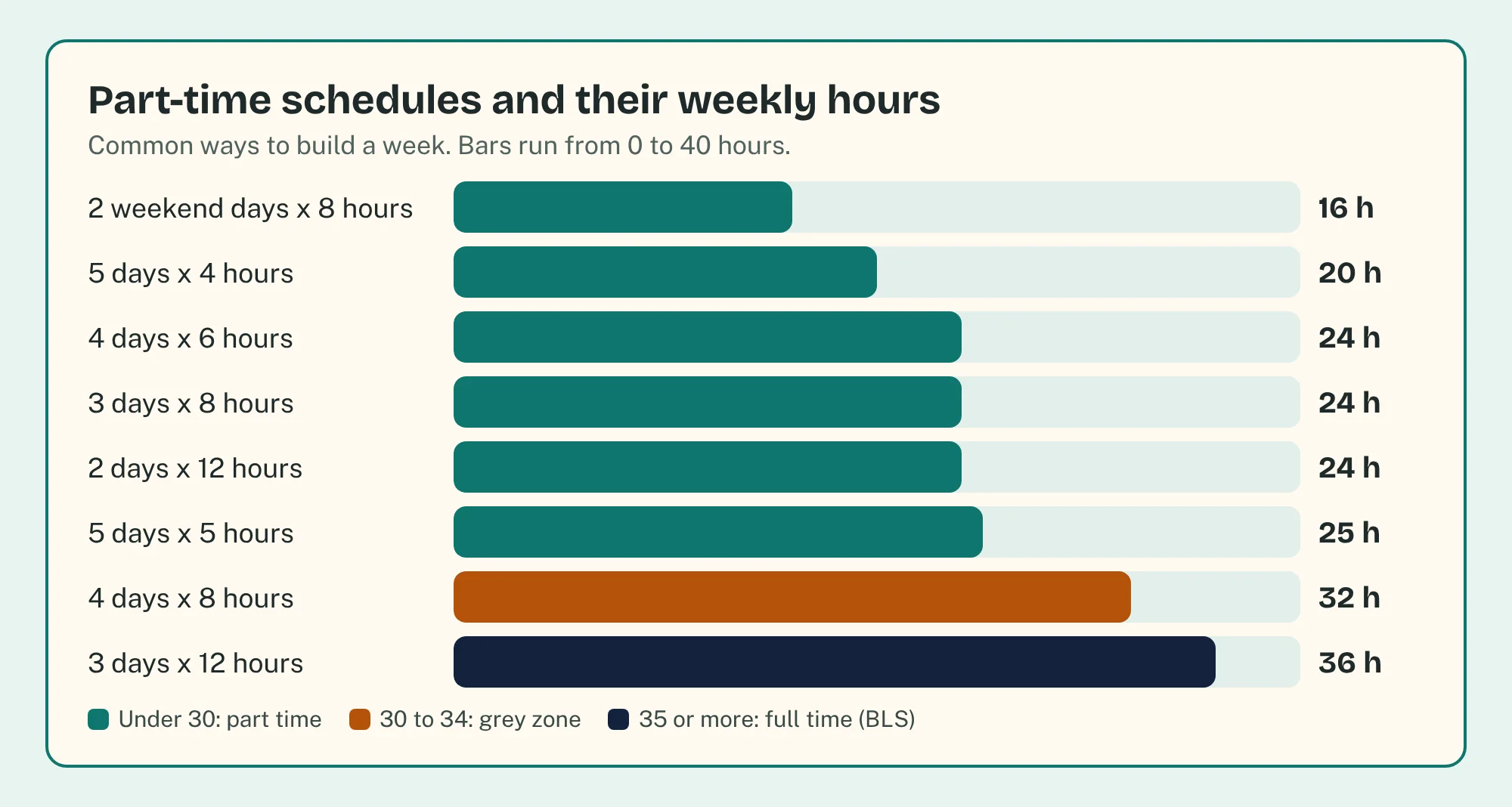
- Five 4-hour days = 20 hours. Typical for a retail or after-school job.
- Five 5-hour days = 25 hours. A common “mornings only” schedule.
- Four 6-hour days = 24 hours. Fits a school-day schedule.
- Three 8-hour days = 24 hours. Full days, with the rest of the week free.
- Two 12-hour shifts = 24 hours. Common in hospitals and warehouses. A third 12-hour shift makes 36 hours, which is full time by the BLS line.
- Two weekend days of 8 hours = 16 hours. Weekend-only work.
- Four 8-hour days = 32 hours. The grey zone. The BLS calls it part time, but ACA health coverage rules treat 30 or more hours as full time.
Working 12-hour or overnight shifts? See the shift hours guide, and the daily hours rules.
Part time vs full time at a glance
| Topic | Part time | Full time |
|---|---|---|
| Typical hours | Under 35 a week (BLS), often 15 to 29 | 35 to 40 a week |
| Minimum wage | Same as full time | Same as part time |
| Overtime | Over 40 hours in a week, if non-exempt | Over 40 hours in a week, if non-exempt |
| Health coverage offer (ACA) | Not required under 30 hours a week | Large employers must offer it at 30+ hours |
| Paid time off, retirement plan | Set by the employer, sometimes prorated | Set by the employer |
| Pay | Hours worked × rate | Hours worked × rate, or a salary |
The main legal difference is small. Under the FLSA, part-timers are covered the same way as full-timers. The big gaps are in benefits, and those mostly come from your employer, not from the law.
Do part-time workers get overtime?
Yes, when they are non-exempt hourly workers. Federal overtime depends on hours worked in a workweek. It does not depend on whether the job is called part time (DOL Fact Sheet #23).
Example. A part-timer earns $18 an hour and normally works 24 hours. One week she covers a colleague and works 44 hours for the same employer. The first 40 hours pay 40 × $18 = $720. The 4 extra hours pay 4 × $27 = $108. Total $828.
Check your own week in the overtime calculator. Some states, such as California, also pay overtime by the day. See the California overtime calculator.
Benefits and rights for part-time workers
Part time does not mean fewer rights. Here is what applies, and where hours make a difference:
- Minimum wage and overtime. The same as for full-time workers, with any higher state or city minimum.
- Health coverage. A large employer must offer coverage to employees who average 30 or more hours a week. Under 30, it is optional.
- Family and medical leave (FMLA). One test is 1,250 hours of service in the 12 months before leave. That is about 24 hours a week, so many part-timers qualify. You also need 12 months with the employer, and the employer must have 50 or more employees within 75 miles of your worksite (DOL Fact Sheet #28).
- Paid time off and retirement plans. No federal rule. Many employers prorate them by hours worked.
- Paid sick leave. Some states and cities require it, and part-timers usually earn it by the hour. Ask your state labor department.
Because a few hours can change what you qualify for, keep a record of your real hours.
How to track part-time hours
Part-time schedules often change week to week, so a simple record helps. It also protects you if a pay question comes up. Follow these steps:
- Write the start and end time of each shift, on the day you work it.
- Subtract unpaid breaks. A 30-minute unpaid lunch comes off the total.
- Convert to decimals if your payroll uses them: 4:30 is 4.5 hours. See the hours to decimal calculator.
- Add up the week with the weekly hours calculator.
- Compare with your threshold, whether that is 30 hours for coverage, 1,250 hours a year for FMLA, or 40 hours for overtime.
Worked example. A week at $15 an hour:
| Day | Start | End | Unpaid break | Paid hours |
|---|---|---|---|---|
| Monday | 9:00 AM | 1:30 PM | None | 4.50 |
| Tuesday | 9:00 AM | 1:00 PM | None | 4.00 |
| Thursday | 12:00 PM | 6:30 PM | 30 min | 6.00 |
| Friday | 9:00 AM | 1:30 PM | None | 4.50 |
| Saturday | 10:00 AM | 3:00 PM | None | 5.00 |
| Week total | 24.00 |
24 hours × $15 = $360. That is part time on every yardstick, and about 1,248 hours over a year, just under the 1,250-hour FMLA test. A single extra hour a week would cross it. Use the time card calculator with lunch for weeks with unpaid breaks, or the time card calculator for the full week. Prefer paper? Grab a free timesheet template.
 Built and checked by Shehroz Shafiq, founder of TimeCardPal. Calculations are checked against hand-worked examples. Last updated 12 November 2026. About us
Part-time mix-ups to avoid
- “Part time” is not a legal status. The law does not define it, so your contract and handbook matter more than the label.
- 30 hours is not the same line everywhere. It is full time for ACA coverage, but part time in BLS statistics.
- Forgetting unpaid breaks. A 30-minute lunch on a 5-hour shift changes the total and your pay.
TimeCardPal gives general information and estimates, not legal, tax or payroll advice. Part-time rules vary by employer, state and contract. Check with your state labor department or an employment lawyer for your situation.
Frequently asked questions
How many hours is considered part time?
There is no single federal number. The US Bureau of Labor Statistics counts 1 to 34 hours a week as part time. Many employers use under 30 hours, and many people work 15 to 29 hours.
How many hours a week is part time?
Usually less than 35 hours a week. Under 30 hours is part time everywhere. At 30 to 34 hours it depends on who is counting: the BLS says part time, but ACA health coverage rules treat 30 or more as full time at large employers.
How many hours a day is part time?
On a five-day week, 4 to 6 hours a day is typical, which is 20 to 30 hours a week. Some part-timers work fewer, longer days, such as two 12-hour shifts, which is 24 hours.
How many hours a month is part time?
About 87 hours a month at 20 hours a week, and under 130 hours a month for most definitions of part time. A week of 30 hours is about 130 hours a month, which is the ACA full-time line.
Is 30 hours a week part time?
It can be either. The BLS calls 30 hours part time. The ACA full-time line is an average of 30 hours a week, so a large employer must offer you health coverage. Your employer decides what it calls the job.
Is 32 hours a week part time or full time?
By the BLS line it is part time, because that line is 35 hours. For ACA health coverage at a large employer it counts as full time. Some employers call 32 hours full time for pay and benefits.
Is 35 hours a week part time or full time?
Full time by the BLS line, which starts at 35 hours. Some employers set full time at 37.5 or 40 hours, so check your contract or handbook.
Is 20 hours a week part time?
Yes. Twenty hours a week is part time on every common yardstick. It works out to 4 hours a day over five days, or about 87 hours a month.
What is the minimum number of hours for a part-time job?
There is no federal minimum. The BLS counts anyone who works 1 hour or more as employed. Your employer sets the minimum hours for the role.
Do part-time workers get overtime?
Yes, if they are non-exempt. Overtime is based on hours worked in a workweek, not on being full or part time. Most hourly workers get 1.5 times their regular rate for hours over 40 in the week.
Do part-time employees get benefits?
Federal law does not require most benefits such as paid time off or a retirement plan for part-timers. Employers decide, and some states and cities require paid sick leave. Large employers must offer health coverage to employees who average 30 or more hours a week.
Can I work two part-time jobs?
Yes. Overtime is usually counted for each employer separately, so 25 hours at one job and 25 at another is not 50 hours for overtime. If the two employers are related, the hours may be added together, so ask your payroll team.
Cite or link to this page
If this page helped your readers, you are welcome to link to it.
TimeCardPal. “How Many Hours Is Part Time?.” https://timecardpal.com/blog/how-many-hours-is-part-time/ (accessed 2026).